What are the rules of a 4×4 KenKen puzzle?
Use only 1–4. Every row and every column contains each number once. Unlike standard Sudoku, there is no separate 2×2 box rule. Instead, the thick outlines mark arithmetic cages. A clue such as 5+ means the cage numbers add to 5; 12× means they multiply to 12. For the two-cell subtraction and division cages in this example, use the larger number minus or divided by the smaller. A cage marked 3− therefore has a difference of 3, not a negative total. A one-cell cage gives its number directly.
These rules follow KenKen's official basic instructions. Numbers may repeat in a cage only when the row and column restrictions still allow it. Our two-cell cages share a row or column, so their numbers must differ.
Try the original practice puzzle
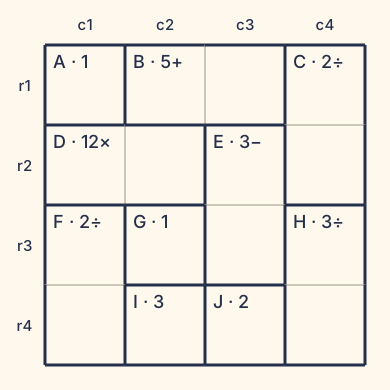
Rows run from top to bottom; columns run from left to right. r2c3 means row 2, column 3. The letters identify cages; they are not numbers to enter. Copy the empty grid onto paper and use the table if you prefer text to a diagram.
| Cage | Squares | Clue |
|---|---|---|
| A | r1c1 | 1 |
| B | r1c2, r1c3 | 5+ |
| C | r1c4, r2c4 | 2÷ |
| D | r2c1, r2c2 | 12× |
| E | r2c3, r3c3 | 3− |
| F | r3c1, r4c1 | 2÷ |
| G | r3c2 | 1 |
| H | r3c4, r4c4 | 3÷ |
| I | r4c2 | 3 |
| J | r4c3 | 2 |
This is an original Floor 2½ teaching example, rather than a copied daily KenKen puzzle. It deliberately includes four single-cell clues to make a first solution approachable. The grid and every cage have been checked; there is exactly one solution. This page is a written exercise, and Floor 2½ does not host a playable KenKen game.
How do you solve it without guessing?
- Fill the single-cell cages. A gives r1c1 = 1, G gives r3c2 = 1, I gives r4c2 = 3 and J gives r4c3 = 2.
- Finish row 4. Its two empty squares need 1 and 4. H is a two-cell 3÷ cage: within 1–4, its only pair is 1 and 3. So r4c4 must be 1, and r4c1 is 4.
- Use the two vertical division cages. F has 4 at r4c1 and a target of 2÷, so r3c1 = 2. H has 1 at r4c4 and a target of 3÷, so r3c4 = 3.
- Finish row 3, then use subtraction. Row 3 is now 2, 1, blank, 3, so r3c3 = 4. E has a difference of 3: its other square, r2c3, must be 1.
- Finish column 3, then the top row. Column 3 has blank, 1, 4, 2, so r1c3 = 3. B adds to 5, so r1c2 = 2. Row 1 is 1, 2, 3, blank, making r1c4 = 4.
- Complete row 2. C divides to 2 and already has 4 at r1c4, so r2c4 = 2. Column 1 is 1, blank, 2, 4, so r2c1 = 3. Row 2 then needs 4 at r2c2. Check D: 3 × 4 = 12.
Each move comes from a cage restriction and numbers already placed in a row or column. You do not need to guess an unseen value.
Check the full answer
| c1 | c2 | c3 | c4 | |
|---|---|---|---|---|
| r1 | 1 | 2 | 3 | 4 |
| r2 | 3 | 4 | 1 | 2 |
| r3 | 2 | 1 | 4 | 3 |
| r4 | 4 | 3 | 2 | 1 |
Check rows and columns first: each contains 1–4 exactly once. Then check B: 2 + 3 = 5; C: 4 ÷ 2 = 2; D: 3 × 4 = 12; E: 4 − 1 = 3; F: 4 ÷ 2 = 2; H: 3 ÷ 1 = 3. A, G, I and J match their single-cell clues.
To verify uniqueness independently, we enumerated all 576 possible 4×4 grids that obey the row and column rule, then tested every cage. One grid passed. A separate step check tested each placement against only the current partial grid and feasible values in its cage; all 16 placements were forced. These checks establish this example's correctness, not a difficulty rating for all beginners.
Common first-puzzle questions
Can a number repeat inside a cage?
Yes, if those squares are in different rows and different columns. A cage does not replace the no-repeat rule. In this example, each multi-cell cage is a two-cell line, so repeats would break a row or column rule.
Does the order matter for subtraction and division?
For this example's two-cell cages, read 3− as the difference between the two values and 2÷ as the larger value divided by the smaller. You do not have to place the larger number in the first square. Addition and multiplication also do not depend on order.
Is KenKen the same as Sudoku or a matching game?
KenKen shares the row-and-column idea with Sudoku, but uses arithmetic cages instead of Sudoku's box constraint. It is also different from the swaps, collection slots and merges in our matching-game collection. If you want another kind of browser puzzle afterwards, that collection explains the available choices.
Sources and authorship
Rules checked against KenKen's official basic instructions on 3 October 2026. The official site also provides its own beginner tutorial. This puzzle, diagram and walkthrough were created by Floor 2½. KenKen® is a registered trademark of KenKen Puzzle, LLC; this is an independent guide with no official endorsement.